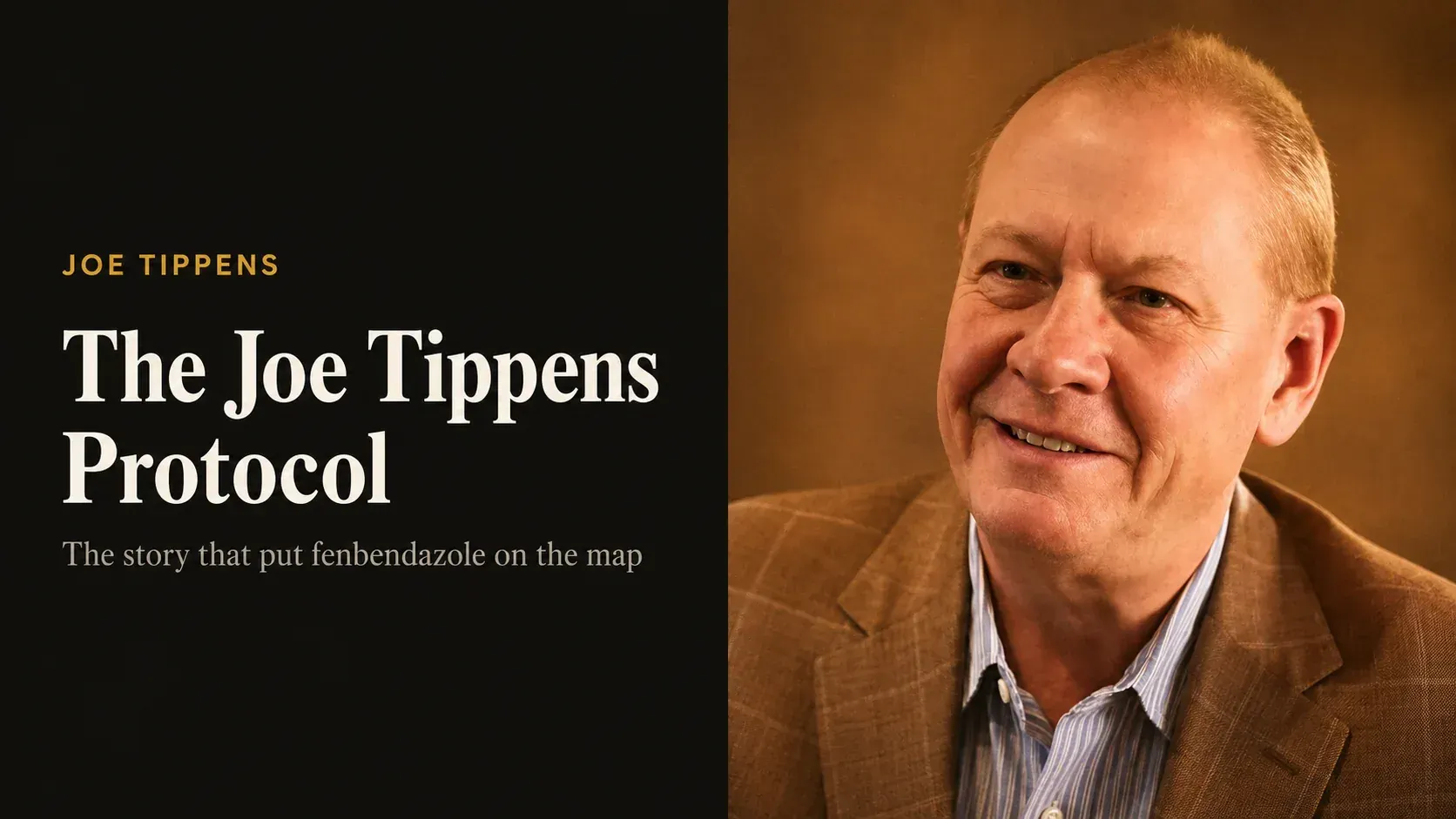
Short answer: The Joe Tippens protocol is a self-reported regimen of fenbendazole 222 mg (originally 3 days on, 4 days off; later daily) plus vitamin E succinate, curcumin and CBD oil. It has never been tested in a clinical trial: Tippens was also receiving pembrolizumab (Keytruda) in a trial when his stage IV small-cell lung cancer went into remission, so the result cannot be attributed to fenbendazole. Evidence for fenbendazole against cancer is limited to cell and animal studies and case reports; it is not approved for human use and has been linked to liver injury.
In this investigation, we dissect the Joe Tippens protocol claim by claim — separating verified science from viral mythology, and revealing critical details most sources conveniently omit.
Quick Overview
- Author: Joe Tippens
- Goal: Anti-cancer supplementation protocol based on fenbendazole combined with supporting compounds
- Duration: Original cycle: 3 days on / 4 days off; Updated version: daily, no breaks
- Key compounds: Fenbendazole, vitamin E succinate, curcumin, CBD oil
- Cycles: Indefinite, with prophylactic variants for survivors and healthy individuals
Overview
The Joe Tippens protocol is a self-reported supplementation regimen centered on fenbendazole, a broad-spectrum anthelmintic drug used in veterinary medicine. The protocol gained widespread attention after Joe Tippens, diagnosed in 2016 with stage IV small-cell lung cancer with metastases throughout his body, reported significant improvement on subsequent PET scans after beginning the regimen in January 2017. The suggestion to use fenbendazole came from a veterinarian acquaintance who had observed unexpected tumor suppression in laboratory animals receiving the compound.
Tippens combined fenbendazole with vitamin E succinate, curcumin, and CBD oil in his original protocol. He has documented his ongoing regimen on his personal blog, mycancerstory.rocks. Over time, he updated the protocol to include daily fenbendazole use and additional proprietary supplement formulations marketed as the Onco Adjunct Pathway series. Maintenance and prophylactic versions of the protocol have also been described for cancer survivors and people without a cancer diagnosis.
The protocol has not been evaluated in formal clinical trials as a combined regimen. Laboratory research has identified plausible mechanisms by which fenbendazole may affect cancer cells, but no controlled human studies have confirmed the efficacy or safety of this specific combination at these doses. The information presented below is for educational purposes only.
⚠️ CRITICAL SAFETY WARNING
This protocol has NOT been validated in human clinical trials for cancer treatment. The substances described carry serious risks including unknown long-term effects from sustained high-dose use of a veterinary anthelmintic never tested at these doses in humans. Fenbendazole is approved only as a veterinary anthelmintic (dewormer); it is not an approved human cancer therapy.
Do NOT attempt this protocol without direct supervision by a board-certified oncologist. Self-medicating with unproven substances can delay effective treatment and cause serious harm. This article is published for educational purposes only and does not constitute medical advice.
Dosage and Schedule
Original Protocol (3 days on / 4 days off)
This is the protocol Tippens used when actively addressing cancer. The 3-days-on / 4-days-off cycle was based on his personal experience.
- Fenbendazole: 222 mg once daily for 3 consecutive days, then 4 days off. One gram of Panacur C or Safeguard granules (which contain 222 mg of fenbendazole per gram of product). Always taken with a fatty meal to improve absorption. Liquid form (100 mg/ml): 2.2 ml daily on dosing days.
- Vitamin E succinate: 400–800 mg daily, 7 days a week. Tippens used Gamma E (Life Extension) or Perfect E (Vitamin Discount Center).
- Curcumin: 600 mg — 2 tablets daily, 7 days a week. Tippens used Theracurmin HP (Integrative Therapeutics).
- CBD oil: 25 mg daily, 7 days a week.
Updated Protocol (daily, no breaks)
After his initial period of recovery, Tippens updated his protocol. The updated version removes the 3-days-on / 4-days-off cycle in favor of continuous daily fenbendazole use and incorporates the Onco Adjunct Pathway supplements.
- Fenbendazole: 222 mg every day, no breaks. Liquid form: 2.2 ml daily.
- Onco Adjunct Pathway 1: 2–4 ml twice daily, dose based on body weight.
- Onco Adjunct Pathway 2: 3 capsules twice daily — taken only when not on chemotherapy.
- Onco Adjunct Pathway 3: 1 capsule with a light meal, 2 capsules with a heavy meal. Described as designed to reduce cancer cell access to glucose.
- Onco Adjunct Pathway 4: 2 capsules twice daily.
Mechanism of Action
Fenbendazole
Fenbendazole belongs to the benzimidazole class of anthelmintics, which act primarily by binding to tubulin and disrupting the tubulin-microtubule equilibrium in parasites. In a 2018 study published in Scientific Reports, Dogra et al. demonstrated that fenbendazole exerts cytotoxicity in human cancer cell lines through three concurrent mechanisms: moderate destabilization of microtubule polymerization (interfering with mitotic spindle formation), activation and mitochondrial translocation of the p53 tumor suppressor protein (promoting apoptosis), and inhibition of glucose uptake through downregulation of GLUT transporter proteins and hexokinase II (HKII), a key glycolytic enzyme. In a mouse xenograft model, orally administered fenbendazole reduced tumor size and vascularity. Cells with wild-type p53 showed enhanced sensitivity to fenbendazole-induced apoptosis.
A separate study by Gao, Dang, and Watson (2008) in the Journal of the American Association for Laboratory Animal Science found that fenbendazole alone did not significantly inhibit tumor growth in SCID mice, but the combination of fenbendazole with supplementary vitamins produced significant tumor growth inhibition. The mechanism of this synergy was not established. These findings suggest that the combination of compounds in the protocol may be relevant to any observed effect, and that fenbendazole in isolation may have limited activity in some models.
Vitamin E Succinate
Vitamin E succinate (alpha-tocopheryl succinate, alpha-TOS) is a redox-silent ester of vitamin E. Unlike alpha-tocopherol (the standard form of vitamin E), alpha-TOS has been shown to induce apoptosis selectively in malignant cells without significant toxicity to normal cells. Studies published in Cancer Research (Neuzil et al., 2002) and the British Journal of Cancer (Neuzil et al., 2003) describe the compound’s ability to trigger mitochondrial apoptotic pathways, mobilize Fas receptor activity, and cooperate with TRAIL in suppressing tumor growth in vivo. Its anticancer activity is attributed to the succinate ester group rather than antioxidant properties; it functions through a pro-apoptotic rather than antioxidant mechanism.
Curcumin
Curcumin is the principal bioactive polyphenol in turmeric (Curcuma longa). Laboratory studies have shown that curcumin inhibits cancer cell proliferation and induces apoptosis through multiple pathways, including activation of p53, suppression of NF-kB and STAT3 signaling, inhibition of the Akt/mTOR pathway, and induction of reactive oxygen species (ROS)-mediated mitochondrial cell death. A review published in Biomedicines (2021) summarizes curcumin’s documented activity across multiple cancer types in preclinical models. Bioavailability of standard curcumin formulations is limited; highly bioavailable forms such as Theracurmin (the brand specified by Tippens) have been developed to improve systemic absorption.
CBD Oil
Cannabidiol (CBD) is a non-psychoactive cannabinoid derived from Cannabis sativa. A 2022 review published in Biology ( Hung et al.) summarizes preclinical evidence suggesting CBD induces apoptosis and inhibits invasion, migration, and metastasis in cancer cell lines through mechanisms including activation of CB1, CB2, and TRPV1 receptors, induction of ROS, and modulation of pro- and anti-apoptotic proteins. Most evidence is derived from in vitro and animal studies. Tippens included CBD oil at 25 mg per day in both the original and prophylactic protocols; the specific contribution of CBD to any observed effect in humans remains unclear.
Optional and Alternative Variants
For Cancer Survivors (relapse prevention)
Once cancer is in remission, Tippens recommends a reduced maintenance schedule rather than stopping the regimen entirely.
- Fenbendazole: 222 mg, 3 times per week (for example, Monday / Wednesday / Friday), taken with a fatty meal. Repeat indefinitely.
- Curcumin: 600 mg — 2 tablets daily, no breaks.
- CBD oil: 25 mg daily, no breaks.
- Monitoring: Tumor marker blood tests every few months. Annual full imaging. After 5 years cancer-free, testing frequency may be reduced.
For Healthy Individuals (prophylactic use)
- Fenbendazole: 222 mg, 3 times per week, taken with a fatty meal. Take for 10 weeks, then stop for 10 weeks. Repeat the cycle.
- Curcumin: 600 mg — 2 tablets daily, no breaks.
- CBD oil: 25 mg daily, no breaks.
Important Considerations
Fenbendazole is not approved by any regulatory authority for the treatment of cancer in humans. All laboratory evidence for its anti-neoplastic activity is derived from in vitro studies and animal models. No randomized controlled clinical trials have evaluated the efficacy or safety of fenbendazole as a cancer therapy in humans, nor has this specific combination regimen been assessed in formal studies.
The Onco Adjunct Pathway products referenced in the updated protocol are proprietary formulations with no independent clinical trial data. Their inclusion reflects Tippens’ personal protocol evolution and should not be interpreted as evidence of efficacy.
Fenbendazole may interact with other medications and treatments. The combination of multiple bioactive compounds at these doses may affect liver enzyme function, drug metabolism (particularly cytochrome P450 pathways), or the efficacy of concurrent chemotherapy. Curcumin at high doses has known interactions with anticoagulants and other drugs. CBD may interact with medications metabolized by the CYP450 system.
Reports of self-administration of fenbendazole in cancer patients have documented cases where it was taken without physician supervision and concurrent with other treatments, making it impossible to attribute observed outcomes to fenbendazole specifically.
This protocol has not been evaluated in formal clinical trials as a combined regimen. The information presented is for educational purposes only. Always consult a qualified healthcare professional before starting any new treatment protocol.
The Keytruda Confounder: The Immunotherapy Trial They Don't Mention
Every retelling of the Joe Tippens story emphasizes the same dramatic arc: terminal small-cell lung cancer, a veterinarian's tip about dog dewormer, and a miraculous scan showing no evidence of disease. What gets left out — or reduced to a footnote — is the single most important medical fact in the entire story: at the time Joe Tippens started fenbendazole, he was already enrolled in a clinical trial for pembrolizumab (Keytruda) at MD Anderson Cancer Center. This is not a minor detail. It is the confounding variable that makes it scientifically impossible to attribute his remission to fenbendazole.
The timeline that matters:
- 2016: Joe Tippens was diagnosed with metastatic (stage 4) small-cell lung cancer (SCLC), one of the most aggressive cancer types, and given a limited prognosis.
- He sought treatment at MD Anderson Cancer Center — one of the top cancer hospitals in the world — where he was enrolled in a clinical trial for pembrolizumab (Keytruda), an FDA-approved immune checkpoint inhibitor.
- He then added fenbendazole and supplements on his own, based on a tip from a veterinarian.
- When his subsequent scans showed remission, he attributed it to the fenbendazole — not to the FDA-approved immunotherapy he was simultaneously receiving in a clinical trial at a world-class cancer center.
What pembrolizumab actually does in small-cell lung cancer:
Pembrolizumab (Keytruda) is a PD-1 immune checkpoint inhibitor that unleashes the body's own immune system against tumor cells. Unlike chemotherapy, immunotherapy can produce durable, long-lasting remissions in a subset of patients — and this is exactly the pattern seen in the Tippens case. The clinical trial data is well-documented:
- KEYNOTE-28 (Phase Ib, PD-L1 positive extensive-stage SCLC): objective response rate (ORR) of 33.3%. Responses were fast and durable, with a median time to response of 2.0 months and a median duration of response of 19.4 months.
- KEYNOTE-158 (Phase II, recurrent SCLC): ORR of 18.7% overall, rising to 35.7% in PD-L1 positive patients.
- Durability: In the studies supporting FDA approval, 94% of responding patients maintained their response for 6+ months, 63% for 12+ months, and 56% for 18+ months. Complete responses, while rare (~2%), do occur and can be lasting.
- Case reports document patients achieving complete remission even with negative PD-L1 testing, suggesting that tumor mutational burden and other factors also predict response.
The scientific reality: Joe Tippens was one of the fortunate subset of SCLC patients who responded durably to pembrolizumab immunotherapy. His remission is entirely consistent with the documented efficacy of the Keytruda trial he was enrolled in. There is no way — none — to separate the effect of the FDA-approved immunotherapy from the effect of the fenbendazole he added on top of it. When two interventions are given simultaneously and one of them is a proven cancer immunotherapy with documented durable remission rates, basic scientific reasoning attributes the outcome to the proven intervention, not the unproven one.
The confounding variable problem: Attributing Tippens' remission to fenbendazole while ignoring the pembrolizumab clinical trial is like crediting a lucky rabbit's foot for a car starting when you also turned the key. The proven mechanism (immunotherapy) was present the entire time. This single omitted fact collapses the central claim of the entire protocol.
Myth vs. Evidence: A Point-by-Point Breakdown
The Joe Tippens protocol is surrounded by claims that circulate on social media, YouTube, and testimonial websites. Below is a direct comparison of the most common claims against what the actual evidence shows. This is the fact-check that the promotional content leaves out.
| The Myth (what's claimed) | The Evidence (what's documented) |
|---|---|
| "Fenbendazole cured Joe Tippens' terminal cancer." | Tippens was enrolled in a pembrolizumab (Keytruda) clinical trial at MD Anderson when he achieved remission. Immunotherapy produces durable remissions in 18-33% of SCLC patients (KEYNOTE-28/158). It is impossible to attribute his outcome to fenbendazole when a proven immunotherapy was given simultaneously. His story is a single anecdote with a massive confounding variable — not clinical evidence. |
| "There's strong scientific evidence fenbendazole works against cancer." | Evidence is limited to preclinical (cell culture and animal) studies showing mechanisms like microtubule disruption and glucose metabolism interference. There are ZERO completed, peer-reviewed human clinical trials demonstrating fenbendazole is safe or effective for cancer. Preclinical promise fails in Phase III trials the vast majority of the time. |
| "Thousands of testimonials prove it works." | Testimonials are subject to severe survivorship bias. The patients who took fenbendazole and died are invisible — they don't post updates. Those who improved (often due to concurrent conventional treatment) are highly motivated to share. This reporting asymmetry creates a false impression of efficacy from fundamentally non-representative data. |
| "It's safe — it's just a dewormer with a wide safety margin." | There are documented reports of drug-induced liver injury (DILI) from fenbendazole self-administration, with liver enzymes normalizing only after discontinuation. Human pharmacokinetics and drug interactions are largely uncharacterized. Veterinary-labeled products explicitly state "not for human use." |
| "If it didn't work, why are so many people using it?" | Popularity is not evidence. The protocol went viral through a compelling personal story amplified on social media — the textbook conditions for a health misinformation cascade. Widespread use reflects effective storytelling and desperation, not clinical validation. |
| "Big Pharma is hiding the cure because it can't be patented." | Repurposed and off-patent drugs (aspirin, metformin, thalidomide) are routinely studied and approved when they work. Academic institutions, governments, and nonprofits fund trials of generic drugs. The absence of fenbendazole approval reflects absence of human efficacy data, not a conspiracy. |
| "Remission after starting the protocol proves causation." | This is the post hoc fallacy (after this, therefore because of this). Cancer can also regress due to concurrent treatment, delayed effects of prior therapy, or — rarely — spontaneous remission (estimated 1 in 60,000-100,000 cases). Temporal sequence alone never establishes causation. |
The pattern: Nearly every pillar of the Joe Tippens narrative rests on a logical fallacy — confounding variables (the Keytruda trial), survivorship bias (invisible non-responders), the post hoc fallacy (remission timing), and the appeal to popularity (viral spread). None of these constitute scientific evidence.
Survivorship Bias: Why One Story Can Never Be Data
The single most powerful psychological force driving the Joe Tippens protocol is not the pharmacology of fenbendazole — it is survivorship bias. Understanding this cognitive trap is essential to evaluating any testimonial-driven treatment claim, and it explains why compelling personal stories systematically mislead even intelligent, careful people.
What survivorship bias is:
Survivorship bias occurs when our perception of a treatment's success is based only on the "survivors" — the people who share their positive outcomes — while the experiences of those who did not survive, or whose disease progressed, remain completely invisible. In the context of alternative cancer protocols, this creates a devastatingly false impression that a regimen is curative.
Why testimonials are fundamentally non-representative data:
- Reporting asymmetry. Patients who experience favorable outcomes are highly motivated to share their stories — they post on social media, start blogs, appear in videos, and become advocates. Patients who took the exact same protocol and died, or whose cancer progressed rapidly, are unable or unwilling to report their outcomes. The dead don't post updates. The result is that the publicly visible data is systematically skewed toward success.
- Testimonial amplification. Social media algorithms, podcasts, and curated testimonial databases prioritize emotionally engaging "miracle" narratives over statistical reality. A single dramatic remission story reaches millions; the thousands of quiet failures reach no one. This amplification effect makes rare outcomes appear common.
- Confounding by concurrent treatment. Many "success stories" are heavily confounded by the fact that patients used the alternative protocol alongside conventional treatment (surgery, chemotherapy, immunotherapy). When the patient survives, credit is incorrectly assigned to the alternative remedy while the actual efficacy of the standard-of-care intervention is ignored — exactly what happened in the Tippens case with the Keytruda trial.
- Biological heterogeneity. Cancer is not one disease. Patients vary enormously in tumor biology, stage, genetics, and treatment history. A handful of good outcomes in a heterogeneous population is statistically expected by chance alone and tells us nothing about whether a treatment works.
The hard survival data on alternative-only treatment:
When researchers move past testimonials and analyze large cancer databases, the picture reverses completely. Patients who choose alternative therapy instead of conventional treatment have significantly worse outcomes:
- Large-scale database analyses show patients who opt for alternative therapy and decline conventional treatment are significantly more likely to die within five years of diagnosis compared to those receiving standard care.
- For certain cancers — including breast and bowel cancer — the risk of mortality has been observed to be more than five times higher for patients choosing alternative-only routes.
- This is the data that testimonials hide: for every visible "survivor" who credits an unproven protocol, there are invisible patients who delayed or forwent proven treatment and did not survive.
The critical distinction: alternative vs. complementary.
- Alternative = used instead of conventional medicine. Associated with poorer prognosis and delayed life-saving treatment. This is where the danger lies.
- Complementary = used alongside conventional treatment, typically to manage side effects (e.g., acupuncture for pain, exercise for fatigue). Evidence-based integrative oncology focuses on these supportive therapies without replacing standard care.
The survivorship bias trap: A single remission story — even a genuine, well-documented one — cannot tell you whether a treatment works. It can only tell you that one person had a good outcome for some reason. The people for whom it didn't work are systematically absent from the conversation. This is why medicine relies on controlled trials with denominators, not testimonials with only numerators.
The Spontaneous Remission Baseline: Cancer Sometimes Regresses on Its Own
One of the least discussed facts in the alternative cancer treatment world is that cancer can and does occasionally regress without any curative treatment at all. This phenomenon — spontaneous remission — establishes a baseline rate of "unexplained" recoveries that any anecdotal treatment claim must be measured against.
What the literature shows:
- Spontaneous remission is defined as the partial or complete disappearance of a malignant tumor without curative treatment.
- Historical estimates place the incidence at approximately 1 in 60,000 to 1 in 100,000 cancer cases. Some reports document only 12-24 formally published cases annually, or roughly 1-10 per million.
- However, researchers emphasize these numbers are likely significant underestimates. Contributing factors to underreporting include incomplete documentation, difficulty distinguishing spontaneous events from the lingering effects of prior treatment, and physicians' reluctance to publish cases that deviate from expectations.
- For small, screen-detected tumors the rate appears far higher. A notable Norwegian breast cancer screening study estimated that ~22% of invasive breast cancers detected via mammography underwent spontaneous regression before causing clinical symptoms.
Factors associated with spontaneous remission:
- Immune activation. A high fever from infection is the most frequently cited factor in case reports — the immune response triggered by infection may inadvertently stimulate anti-tumor activity. (Notably, this is an immune mechanism, the same category as the pembrolizumab Tippens received.)
- Hormonal shifts (e.g., menopause transitions in breast cancer).
- Cancer type. Certain malignancies — neuroblastoma (especially Stage 4S), melanoma, kidney cancer, leukemia, and lymphoma — are notably more prone to spontaneous regression than others.
Why this matters for the Joe Tippens protocol:
- Every alternative treatment claim must contend with the fact that some cancers regress on their own, and some patients respond durably to concurrent conventional treatment. When a person takes an unproven protocol and improves, at least three explanations compete: (1) the protocol worked, (2) concurrent conventional treatment worked, or (3) the cancer regressed for other reasons (spontaneous remission, immune activation, delayed prior-treatment effect).
- With no control group, no denominator, and confounding treatments present, there is no way to distinguish between these explanations from a single anecdote. The scientific default is to attribute outcomes to documented mechanisms (immunotherapy, prior chemotherapy) before crediting an unproven intervention.
- This is precisely why the plural of "anecdote" is not "data." A collection of remission stories, even a large one, cannot separate genuine treatment effect from the background rate of spontaneous remission plus concurrent-treatment effect plus survivorship bias.
The baseline problem: Cancer regresses on its own at a measurable (and probably underestimated) rate. Add concurrent conventional treatment and survivorship bias, and a certain number of "success stories" are statistically guaranteed to appear around ANY popular intervention — whether it works or not. Distinguishing real effect from background noise requires controlled trials, which fenbendazole does not have.
How the Protocol Went Viral
The protocol's reach is inseparable from its origin story. In 2016 Joe Tippens, a former materials-industry executive from Oklahoma, was diagnosed with small-cell lung cancer; by the following year it had metastasised widely and he was given a terminal prognosis. On the advice of a veterinarian he began taking fenbendazole alongside a clinical trial of the immunotherapy drug pembrolizumab (Keytruda). When his subsequent scans showed no detectable disease, he published the account on his blog, mycancerstory.rocks, in 2018.
The post spread rapidly through Facebook groups and YouTube, and the regimen became known as the "Joe Tippens protocol." It is essential to note that Tippens received a checkpoint inhibitor at the same time — a therapy independently associated with durable remissions in a subset of lung-cancer patients. Because the two interventions ran concurrently, his individual outcome cannot be attributed to fenbendazole alone, a limitation Tippens himself has acknowledged.
Liver Safety and Monitoring
The single most important documented risk of sustained fenbendazole use in humans is drug-induced liver injury (DILI). Fenbendazole is metabolised in the liver, and several peer-reviewed case reports now describe serious hepatotoxicity in people who self-administered it for cancer:
- A 67-year-old woman presented with two weeks of jaundice and was found to have histologically confirmed severe hepatocellular liver injury after self-administering fenbendazole — reported as the first biopsy-confirmed case of its kind (Thakurdesai et al., ACG Case Reports Journal, 2024).
- A patient with non-small-cell lung cancer developed DILI after starting fenbendazole based on social-media information (Yamaguchi et al., Case Reports in Oncology, 2021).
- A 47-year-old woman with metastatic colon cancer on immunotherapy developed severe hepatocellular injury after increasing her self-administered fenbendazole dose; clinicians used the Roussel Uclaf Causality Assessment Method (RUCAM) and scored the case "probable" for fenbendazole (score 8).
In each case, liver function improved after the drug was stopped, indicating the injury was largely reversible on discontinuation. A recurring diagnostic challenge is that patients on immune-checkpoint inhibitors can also develop immunotherapy-induced hepatitis, making it difficult to separate the two causes without careful workup.
Practical monitoring, if used under medical supervision:
- Obtain a baseline liver-function panel (ALT, AST, ALP, bilirubin) before starting.
- Recheck every 4–6 weeks during the first six months.
- Pause fenbendazole if ALT or AST rises above roughly 2–3× the upper limit of normal, and seek medical review.
- Report any jaundice, dark urine, right-upper-quadrant pain, or unusual fatigue immediately.
Reported Side Effects
Beyond the liver, side effects reported by users are largely anecdotal rather than trial-derived. The table below summarises what has been described in case reports and community accounts, with an honest note on the strength of evidence for each.
| Effect | Description | Evidence level |
|---|---|---|
| Elevated liver enzymes / DILI | Asymptomatic ALT/AST rise up to severe hepatocellular injury | Peer-reviewed case reports |
| Gastrointestinal upset | Nausea, diarrhoea, abdominal discomfort, especially in early weeks | Anecdotal / community reports |
| Fatigue | Transient tiredness | Anecdotal |
| Hair thinning | Mild, reversible; plausibly linked to microtubule effects on dividing cells | Anecdotal / rare |
The absence of controlled trials means the true frequency of any of these effects is unknown, and rare or delayed harms may not yet be documented.
Drug Interactions and Sourcing Risks
Interactions. Fenbendazole and the protocol's supplements are metabolised through hepatic cytochrome-P450 pathways, so overlap with prescription drugs is plausible. Curcumin can affect anticoagulants and may interfere with chemotherapies or radiation that rely on oxidative stress; CBD inhibits several CYP450 enzymes and can raise or lower levels of co-administered medicines. This is why the original vitamin-E component was later dropped from the "official" protocol over bleeding-risk concerns.
Sourcing and quality control. Most fenbendazole taken for this purpose is sold as a veterinary product (for example Panacur C or Safe-Guard). Veterinary manufacturing is not held to human-pharmaceutical standards for dose uniformity, excipient testing, or contaminant limits, so potency and purity can vary between batches. Human-labelled "research" capsules are likewise sold without regulatory approval or verified quality control.
Related Protocols and Further Reading
The Joe Tippens regimen is one of several repurposed-drug approaches discussed on this site. For balanced, sourced comparisons see:
- Fenbendazole, Berberine & Curcumin Protocol
- High-Dose Fenbendazole Protocol
- Fenbendazole & Vitamin E Synergy Protocol
- Fenbendazole Case Reports & Clinical Evidence
- Maximising Fenbendazole Absorption
Sources
📚 Key References & Sources
- Son DS et al. "Fenbendazole has anti-cancer properties." (key preclinical study).
- Dogra N, Kumar A, Mukhopadhyay T. "Fenbendazole acts as a moderate microtubule destabilizing agent." Sci Rep. 2018;8(1):11926. PMID: 30093705 — PubMed.
- FDA Center for Veterinary Medicine: fenbendazole is approved only for veterinary use (animal dewormer) — FDA CVM.
- National Cancer Institute / ClinicalTrials.gov: no completed clinical trials of fenbendazole for human cancer treatment — ClinicalTrials.gov.
- Joe Tippens metastatic SCLC 2016 enrolled pembrolizumab Keytruda clinical trial MD Anderson — confounding factor for remission. Review
- Pembrolizumab SCLC KEYNOTE-28 ORR 33.3% median duration response 19.4 months, KEYNOTE-158 ORR 18.7%. Article
- FDA approves pembrolizumab metastatic SCLC (2019 accelerated approval; indication withdrawn in 2021) — 94% responders maintained 6+ months, 56% 18+ months. FDA
- Spontaneous remission cancer incidence ~1 in 60,000-100,000, ~22% screen-detected breast cancers regress (Norway). Overview
- Alternative-only cancer therapy 5-year mortality significantly higher, breast/bowel over 5x. Cancer Research UK. Analysis
- Alternative medicine survival declines survivorship bias reporting asymmetry testimonials. ACSH. Article
Frequently Asked Questions
What is the Joe Tippens protocol?
Fenbendazole 222 mg (3 on/4 off), vitamin E succinate 800 IU, curcumin 600 mg, CBD oil 25 mg daily. Tippens reported remission from stage IV SCLC.
Did fenbendazole cure Tippens' cancer?
He reported remission while also receiving conventional treatment. Without controlled trials, causation cannot be determined.
What cancer did Joe Tippens have?
Stage IV small-cell lung cancer (SCLC) with metastases—an aggressive cancer with poor prognosis.
How long should you follow it?
No established duration. Some use it indefinitely; others 3-6 months. Consult a healthcare provider.
Was Joe Tippens receiving other cancer treatment when he took fenbendazole?
Yes — this is the critical omitted fact. Tippens was enrolled in a pembrolizumab (Keytruda) clinical trial at MD Anderson when he started fenbendazole and when he achieved remission. Keytruda is an FDA-approved immunotherapy that produces durable remissions in 18-33% of SCLC patients (KEYNOTE-28 ORR 33.3%, median duration of response 19.4 months). It is scientifically impossible to attribute his remission to fenbendazole when a proven immunotherapy was given simultaneously.
Are there human clinical trials proving fenbendazole treats cancer?
No. There are ZERO completed, peer-reviewed human clinical trials demonstrating fenbendazole is safe or effective for cancer. All evidence is preclinical (cell culture and animal models) showing mechanisms like microtubule disruption. Preclinical promise fails to translate to human benefit the vast majority of the time. Neither the FDA nor EMA has approved fenbendazole for human use.
Why can't testimonials prove the protocol works?
Survivorship bias. Patients who took fenbendazole and died are invisible — they don't post updates. Those who improved (often due to concurrent conventional treatment) are highly motivated to share. This reporting asymmetry makes publicly visible data fundamentally non-representative. Large database analyses show patients choosing alternative-only therapy are significantly more likely to die within 5 years — for breast and bowel cancer, mortality risk is over 5x higher.
Could Joe Tippens' remission have been spontaneous?
Spontaneous remission occurs at roughly 1 in 60,000-100,000 cases (likely underestimated), often triggered by immune activation. However, the most likely explanation in Tippens' case is the pembrolizumab immunotherapy he was receiving — a documented, proven mechanism. With concurrent treatment present and no control group, a single anecdote cannot distinguish between protocol effect, immunotherapy effect, and spontaneous remission.
Is "Big Pharma hiding the cure because fenbendazole can't be patented" a valid argument?
No. Off-patent and repurposed drugs (aspirin, metformin, thalidomide) are routinely studied and approved when they work. Academic institutions, governments, and nonprofits fund trials of generic drugs. The absence of fenbendazole approval reflects absence of human efficacy data, not a conspiracy. If robust trial evidence existed, it would be adopted.
What's the difference between alternative and complementary treatment?
Alternative = used instead of conventional medicine — associated with poorer prognosis and delayed life-saving treatment. Complementary = used alongside conventional treatment to manage side effects (evidence-based integrative oncology). The danger with the Tippens protocol arises when patients use it as a replacement for proven care, risking disease progression and lost treatment windows.
Free · No spam · Unsubscribe anytime
Get the research before the sellers spin it
Join readers getting evidence-based fenbendazole protocols, dosing guides, and honest product investigations — straight to your inbox. We read the studies so you don’t get sold a story.
Subscribe free →⚖️ How we assessed this
Transparency matters. Readers should be aware of the following potential conflicts of interest associated with this protocol:
- Joe Tippens gained fame through a viral blog post about his cancer remission. He received concurrent conventional immunotherapy (Keytruda), which likely contributed to his remission. Multiple fenbendazole supplement brands have used his story for marketing, and Tippens has commercial connections to the fenbendazole supplement industry.
Disclaimer — This content is for educational and informational purposes only. It does not constitute medical advice. Always consult a qualified healthcare professional before starting any treatment protocol.
🔬 How we research & review this article
This article is an evidence-based review. Every clinical claim is sourced from primary literature (PubMed, ClinicalTrials.gov, FDA/WHO). Sources are selected for methodological quality, uncertainties are stated plainly, and conflicts of interest are disclosed. Content is reviewed and updated on a rolling schedule — the publication and update dates are shown next to the author name.