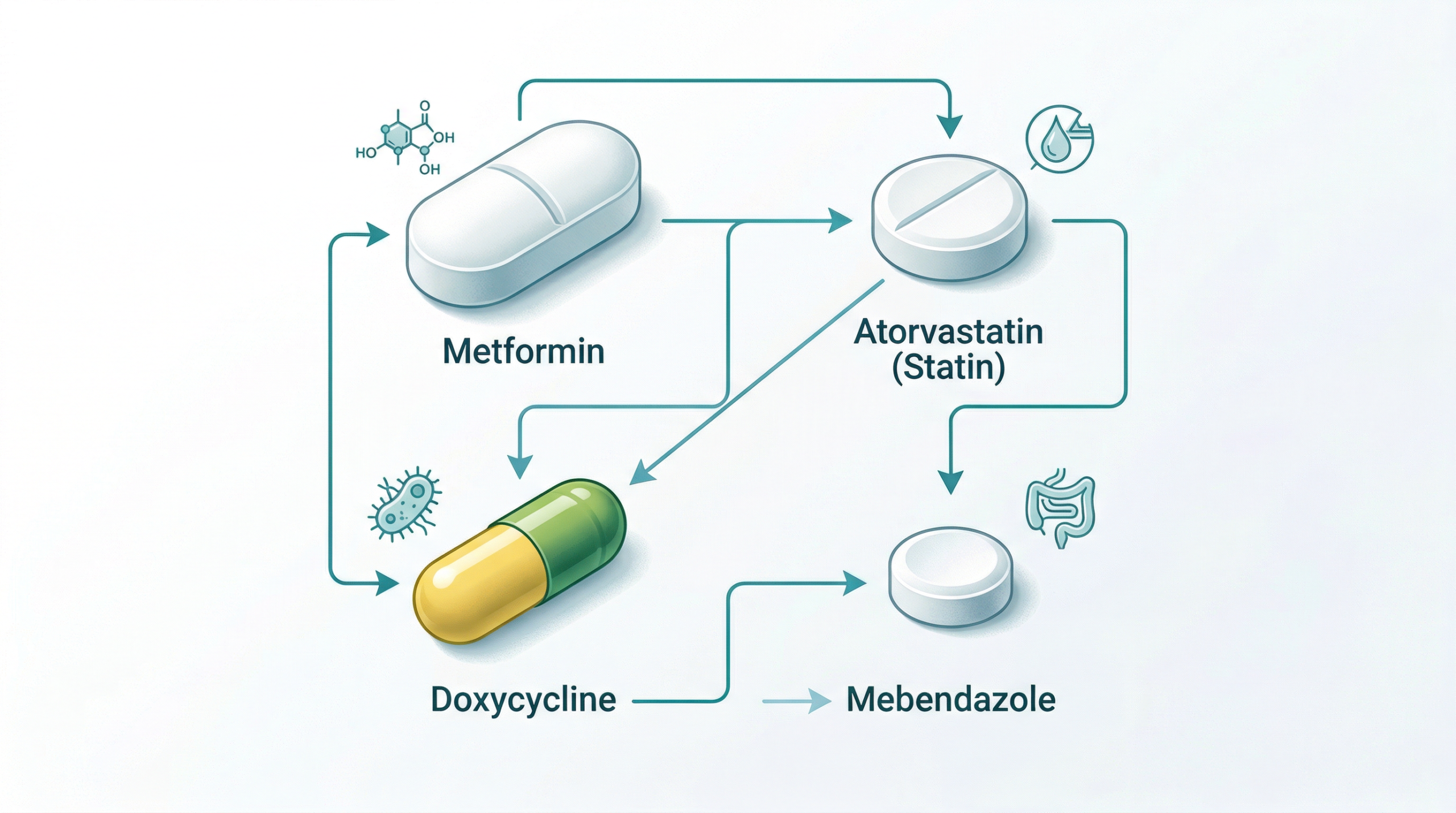
The Care Oncology Protocol (COC): A Clinic-Based Approach
- Author: Dr. Gregory Stoloff (founder); clinical team at Care Oncology Clinic, London
- Goal: Improve overall survival in cancer patients by adding four off-label, metabolically-targeted drugs as adjuncts to standard-of-care oncology treatment
- Duration: Ongoing long-term adjunct to standard of care; no fixed endpoint. Patients typically continue as long as the protocol is tolerated and beneficial.
- Key compounds: Metformin, Atorvastatin, Doxycycline, Mebendazole (and optional Flarin/Ibuprofen)
- Cycles: All four drugs taken daily. Mebendazole and doxycycline may be rotated on a one-month-on / one-month-off alternating schedule, or taken together continuously.
Overview
The Care Oncology Protocol (COC) was developed at the Care Oncology Clinic in London, founded by Dr. Gregory Stoloff, a British physician who previously directed vaccine research. The protocol was built on published mechanistic and observational data suggesting that four widely-used, off-patent drugs independently demonstrate anti-cancer metabolic activity and, in combination, may act synergistically. It was formally registered as a clinical study — the METRICS trial (NCT02201381) — in 2014, making it the most institutionally validated of the metabolic repurposing protocols.
The METRICS study (Metabolic and Repurposed drug Investigative Cancer Study) is a participant-funded, open-label, non-randomized single-arm real-world study classified by the UK MHRA as an “Interventional Service Evaluation.” A retrospective cohort analysis of glioblastoma multiforme (GBM) patients (n=95, treated 2013–2016), published in Frontiers in Pharmacology in 2019, reported a median overall survival of 26.3 months compared to 14.8 months for historical standard-of-care controls from UK Public Health England data. The 2-year survival rate was 55.8% versus 26.5–28.7% in comparable standard-of-care cohorts. In the optimal subgroup (surgery plus chemotherapy plus radiation), 2-year survival reached 64.0% with the COC protocol added. The safety profile was reported as favorable with no drug-related serious adverse events.
It is important to note that the METRICS study carries an Expression of Concern issued in 2023 (Front Pharmacol. 2023;14:1264737) regarding methodological aspects, and the results come from a non-randomized study with potential selection bias. Nevertheless, the COC Protocol has influenced the broader metabolic oncology movement and is considered an institutional prototype of the four-drug metabolic approach. Jane McLelland’s protocol includes all four COC drugs. The clinic operates across the UK and internationally, and the protocol is also available via telemedicine.
Dosage and Schedule
The COC Protocol uses fixed daily doses of four compounds. The table below presents the standard dosing as prescribed at the Care Oncology Clinic, along with administration guidance from official clinic documentation.
| Compound | Standard Dose | Timing | Key Notes |
|---|---|---|---|
| Metformin | 500 mg twice/day (1000 mg/day total); modified-release preferred | With or immediately after meals | Start at 500 mg once/day for 2 weeks, then increase. Omit on day of contrast scans and 48 hours after. |
| Atorvastatin | 40 mg once or twice/day (40–80 mg/day) | Evening preferred (1–2 hours before bedtime or after evening meal) | Can be taken with or without food. |
| Mebendazole | 100–200 mg/day (100 mg standard; 100 mg twice/day in some protocols) | With or without food; fatty meal or chewing improves absorption | May be rotated with doxycycline (1 month on/1 month off) or taken together continuously. |
| Doxycycline | 100 mg once/day | Same time daily; well before bedtime; do not lie down for 30 minutes after | Avoid dairy, antacids, and zinc/iron supplements within 2 hours of dose. |
| Flarin / Ibuprofen (optional 5th) | 200–400 mg, 3×/day | With food | Added case-by-case. Contraindicated with anticoagulants or GI ulcer history. |
The clinic also provides a rotation option for mebendazole and doxycycline: some patients take mebendazole for one calendar month, then switch to doxycycline for the following month. This alternating schedule may reduce the risk of prolonged antibiotic exposure while maintaining alternating mechanism coverage. Other patients take both compounds continuously — the choice is typically made in consultation with the prescribing clinician based on individual case factors.
Mechanism of Action
The four COC drugs collectively target multiple nodes in cancer cell metabolism and proliferation. A key design principle is that each drug addresses a different pathway, creating a multi-pronged attack on cancer cell energy supply, structural integrity, and stem cell survival that is difficult for cancer cells to fully circumvent.
Metformin
Metformin activates AMPK via mitochondrial complex I inhibition, suppressing the mTOR pathway and HIF-1α transcription factor. It reduces IGF-1 and insulin signaling — the molecular basis of the Warburg effect — and inhibits hepatic glucose production, reducing systemic glucose availability for rapidly dividing cancer cells. A 2021 peer-reviewed review confirmed metformin’s anticancer mechanism via AMPK activation and mTOR inhibition. Metformin synergizes with atorvastatin by simultaneously targeting the glycolytic and cholesterol synthetic pathways, an important design feature of the COC combination.
Atorvastatin
Atorvastatin inhibits HMG-CoA reductase in the mevalonate pathway, blocking cholesterol and isoprenoid synthesis required for cancer cell membrane proliferation and post-translational modifications of oncoproteins including RAS and RHO. It also blocks the Glut1 surface receptor, reducing cancer cell glucose uptake independent of the metformin mechanism. A 2018 review of the mevalonate pathway in cancer treatment documented statin-mediated apoptosis through caspase cascade activation and cell cycle arrest. The lipophilic formulation of atorvastatin allows tissue penetration beyond the bloodstream, which is important for solid tumor activity.
Doxycycline
Doxycycline selectively inhibits the mitochondrial 70S ribosome — a prokaryotic-type ribosome present in cancer cell mitochondria — blocking synthesis of oxidative phosphorylation complex proteins. This mechanism targets cancer stem cells with particular specificity, as CSCs are highly dependent on mitochondrial OXPHOS for energy. Research suggests doxycycline reduces cancer stemness in vivo, inhibiting epithelial-to-mesenchymal transition (EMT) and reducing cancer invasion and metastatic potential. It induces CSC apoptosis via ER stress through the ATF4/PUMA pathway.
Mebendazole
Mebendazole disrupts microtubule polymerization by binding to beta-tubulin, preventing mitotic spindle formation and causing mitotic arrest followed by apoptosis. It additionally inhibits VEGFR2 kinase, reducing tumor vasculature formation, and downregulates oncogenic drivers including MYC, COX-2, and Bcl-2. Mebendazole depletes ALDH1+ cancer stem cell populations, impairs glucose and glutamine uptake, and crosses the blood-brain barrier — providing activity in CNS tumors. A 2019 systematic review in Cancers (Basel) documented its activity across multiple tumor types.
Synergistic Multi-Pathway Blockade
The four drugs collectively address: (1) glucose metabolism via metformin and atorvastatin’s Glut1 blockade; (2) fatty acid and cholesterol synthesis via atorvastatin’s mevalonate pathway inhibition; (3) mitochondrial OXPHOS in cancer stem cells via doxycycline; and (4) microtubule-dependent cell division and Warburg effect via mebendazole. This multi-pathway blockade mirrors the principle articulated by Jane McLelland of simultaneous fuel-line disruption, reducing the cancer cell’s ability to reroute energy supply through an unblocked pathway.
METRICS Study Results
- Median overall survival: 26.3 months (vs. 14.8 months historical SoC control)
- 2-year survival rate: 55.8% (vs. 26.5–28.7% for comparable SoC-only cohorts)
- Optimal subgroup (surgery + chemo + radiation + COC): 64.0% 2-year survival
- Drug-related serious adverse events: None reported
- Note: Results are from a non-randomized, open-label study. An Expression of Concern was issued in 2023 regarding methodological aspects.
Important Considerations
This protocol has not been evaluated in formal clinical trials as a combined regimen. The information presented is for educational purposes only. Always consult a qualified healthcare professional before starting any new treatment protocol.
- The METRICS study (NCT02201381) is ongoing; the 2019 published GBM results are preliminary and the study carries an Expression of Concern issued in 2023 regarding methodology.
- The protocol is explicitly designed as an adjunct to standard oncology care — not a replacement for surgery, chemotherapy, or radiation.
- The GBM results (2-year survival ~55–64% vs. historical 26.5%) are compelling but derive from a non-randomized study with potential selection bias.
- Metformin requires monitoring: avoid with eGFR <45, avoid before contrast-enhanced scans, and supplement B vitamins to offset depletion risk.
- Atorvastatin may interact with some chemotherapy agents via the CYP3A4 metabolic pathway; the prescribing oncologist should be informed.
- Mebendazole can elevate liver enzymes; periodic liver function tests (LFTs) are recommended.
- Doxycycline has antibiotic properties; prolonged use may affect gut microbiome. Probiotic supplementation may be advisable.
- The rotation of doxycycline and mebendazole (one month each) is used to reduce prolonged antibiotic exposure while maintaining alternating mechanistic coverage.
- The Care Oncology Clinic charges for consultations; the protocol is not freely available through the UK NHS.
- Agrawal S et al. A New Method for Ethical and Efficient Evidence Generation for Off-Label Medication Use in Oncology (METRICS Study). Front Pharmacol. 2019. PMC
- Care Oncology Clinic. How to take your COC protocol. 2025. Care Oncology Clinic
- Care Oncology Clinic. COC Protocol Medications — Information Sheets. 2025. Care Oncology Clinic
- ClinicalTrials.gov. METRICS Study — NCT02201381. 2014. ClinicalTrials.gov
- CANCERactive. The Care Oncology Clinic, COC Protocol — Review and Analysis. 2025. CANCERactive
- Chomanicova N et al. The role of AMPK/mTOR signaling pathway in anticancer activity of metformin. Physiol Res. 2021. PubMed
- Hindler K et al. Targeting Mevalonate Pathway in Cancer Treatment. 2018. PubMed
- GlioblastomaMultiforme.it. The Care Metabolic Protocol — Synergic Combination of Target Metabolic Drugs as Additional Therapy for GBM. 2020. GlioblastomaMultiforme.it